 Lexipeek
- Home
- Spaced repetition vocabulary app
Guide
What is spaced repetition? A vocabulary app explained from the inside.
Spaced repetition asks you a word just before you forget it. The Leitner system does this with five boxes: a card you know moves forward, a card you miss goes back to the start. This page explains the idea, the evidence behind it, and how Lexipeek turns it into a daily routine on the iPhone Lock Screen.
Lexipeek is for Turkish speakers: the interface and the word meanings are in Turkish. It teaches English words to people who read Turkish. The explanation of spaced repetition below applies to any language pair.
Five boxes, one card
“I know it”: one box forward, the gap grows. “Again”: back to box one, due again today.
Animation: the card advances from box one to box four as you answer “I know it”, then drops back to box one on “Again”.
Definition
What spaced repetition is
Instead of reading a word twenty times in one evening, you spread the repetitions over days: today, tomorrow, three days later, a week later. After each successful recall the gap grows.
Cramming feels productive and works for tomorrow's test; a week later most of it is gone. Spacing spends the same minutes more durably, because each review arrives when forgetting has begun, and the effort of recalling strengthens the memory.
How long should the gap be? In a study by Cepeda and colleagues with more than 1,350 participants, the best gap was about 10–20 percent of the time you want to remember the material: a day or two for a test next week, weeks for months ahead. In Nakata's 2015 vocabulary experiment with 128 learners, the big gain came from spacing at all; expanding gaps beat equal gaps by a small but real margin. Regularity matters more than fine-tuning.
One more finding: studying one large mixed deck beat splitting the same words into four small decks, even though learners believed the opposite (Kornell 2009).
Sources: Cepeda et al. 2008; Nakata 2015, SSLA; Kornell 2009.
Method
The Leitner system
Popularised by the German science writer Sebastian Leitner in the 1970s, the box system is spaced repetition without a calculator: the box number tells you how rarely a word comes back.
Known cards move forward
Word on the front, meaning on the back. Try to recall first, then flip. If you were right, the card moves to the next box and comes back less often.
Missed cards go back to the start
If you could not recall it, the card returns to box one whatever box it was in. No mercy: a box-four word you forgot is back tomorrow.
Box number = interval
Box one is opened every day, box two every three days, box three weekly, box four every two weeks, box five monthly. Hard words often, easy words rarely.
Why it works
Recall first, then look
Spacing only pays off if each review is a real attempt to remember, not a re-read.
In Karpicke and Roediger's experiment, learners who were repeatedly tested on foreign words remembered about 80 percent a week later; learners who only re-studied the words remembered 33–36 percent. Extra studying added nothing once the words had been seen. The same study found that learners' own predictions of how well they would do were unrelated to their actual results, which is why a good app does not rely on “I know it” alone.
In a review of ten study techniques, Dunlosky and colleagues rated practice testing and distributed practice as the two with the highest utility; rereading and highlighting were among the lowest.
Sources: Karpicke & Roediger 2008, Science; Dunlosky et al. 2013, PSPI.
In Lexipeek
Five boxes and an exercise ladder
Lexipeek uses Leitner's boxes as they are and attaches a question type to each box. The higher the word climbs, the harder the question; production is never asked before the word has settled.
| Box | Interval | What is asked |
|---|---|---|
| 1 | 1 day | Flashcard: recall first, then reveal |
| 2 | 3 days | Four options: English to Turkish |
| 3 | 7 days | Four options: Turkish to English |
| 4 | 14 days | Spell the word from scrambled letters |
| 5 | 30 days | Fill the gap in the example sentence; counts as learned |
- Biliyorum (I know it) or a correct answer: one box up, due after the new interval.
- Tekrar (again) or a wrong answer: box one, back at the end of today's queue.
- Emin değilim (not sure): the box stays, the word returns tomorrow.
- A brand-new word goes to box one even if you say you know it; recognising a word at first sight is not the same as knowing it.
- The last answer can be undone within a few seconds.
A word in box five never leaves the deck; it keeps coming back every 30 days and starts over if forgotten. The due cards also appear on the Lock Screen: how to add the widget.
Why production comes late: for spelling, recall beats recognition (Nakata 2016); multiple-choice with plausible distractors strengthens related knowledge too (Little & Bjork 2014).
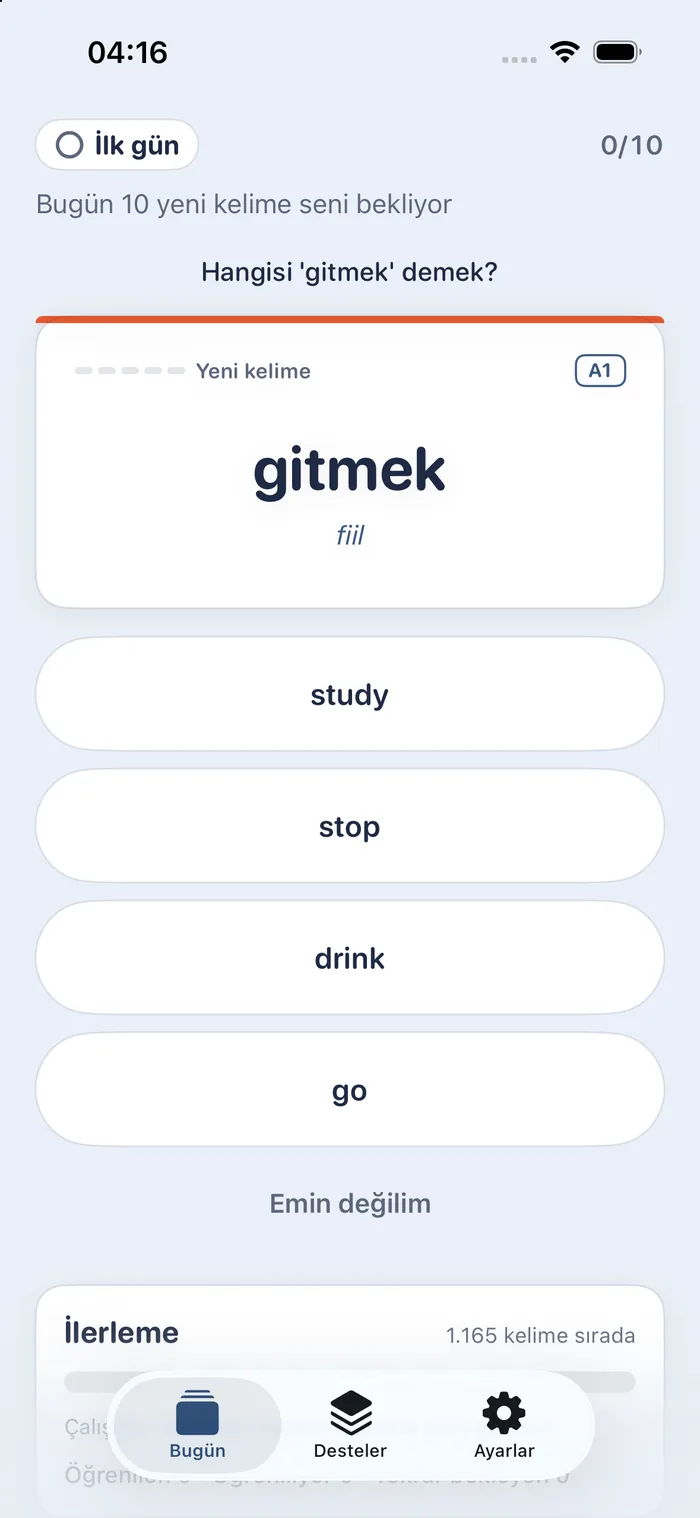
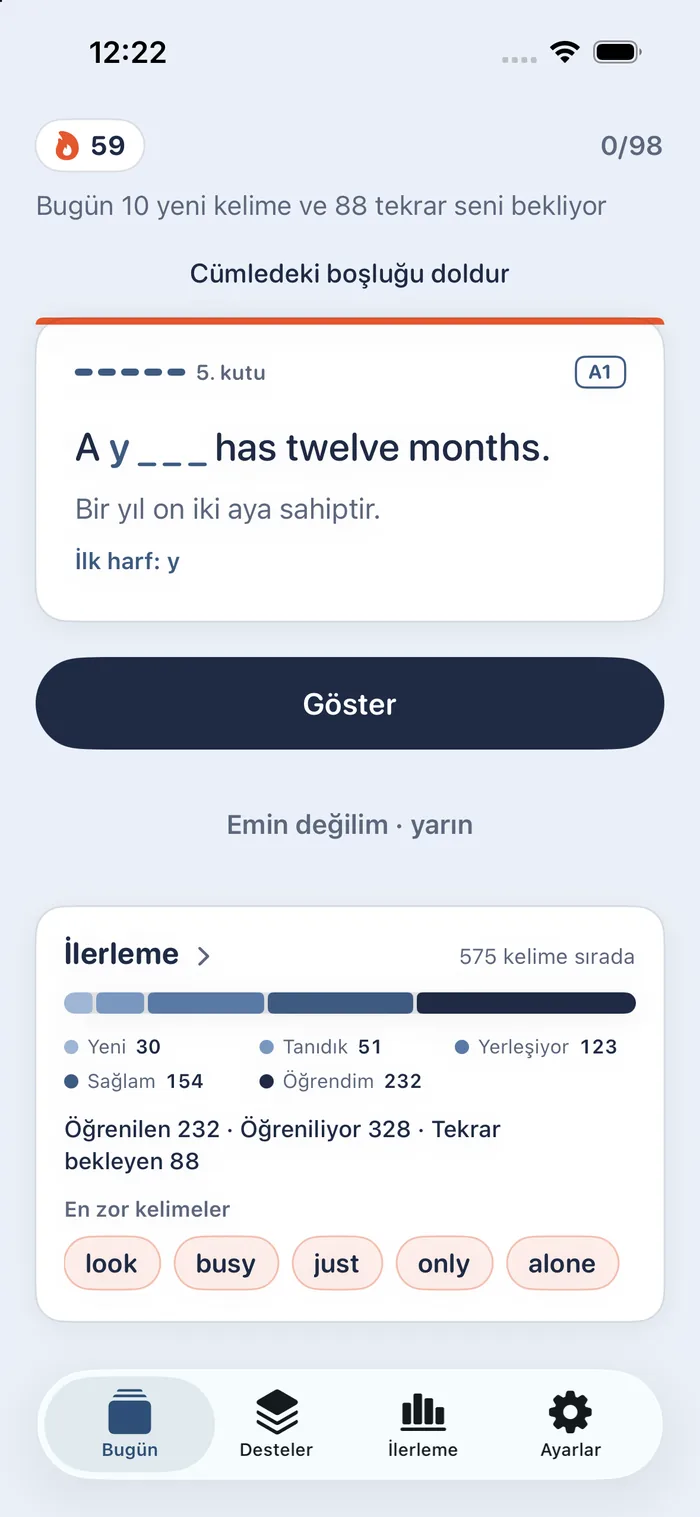
Real screenshots (iOS 26 simulator); the app is in Turkish.
FAQ
About spaced repetition
What is spaced repetition?
Spreading reviews of the same item over time instead of repeating it many times in one sitting: today, tomorrow, three days later, a week later. After each successful recall the gap grows. In experiments, spaced study is remembered longer than massed study of the same duration; the best gap is roughly 10–20 percent of how long you want to remember the material (Cepeda et al. 2008).
How does the Leitner system work?
Cards sit in five boxes. A new card enters box one. A card you know moves up one box; a card you miss drops back to box one, whatever box it was in. Box one is reviewed every day, box two every three days, box three weekly, box four every two weeks, box five monthly. Hard words come often, easy words rarely.
Is Lexipeek a free spaced repetition app?
Spaced repetition, every widget, the A1 and A2 decks (2,674 words), the first 100 B1 words, Progress and audio review are free, with no ads and no account. Plus unlocks the rest of B1, B2, the academic decks and your own words, as a yearly or lifetime purchase; there is no trial and no weekly plan. Note that the app is in Turkish.
What happens if I miss a day?
Nothing is lost. Cards that were due wait in the queue and come first the next day, followed by that day's cards. The streak forgives one empty day a week automatically; the forgiveness is free and cannot be bought.
Read next
Related guides
The boxes and the calendar, handled for you
Lexipeek brings the five boxes, the 1-3-7-14-30 day schedule and a question for each box, and puts the word you are about to forget on your Lock Screen. Spaced repetition, the A1 and A2 decks and every widget are free. For Turkish speakers; the interface is in Turkish.
Coming soon to the App Store
- No account
- No ads
- No weekly plan